
It rains for a week, and then one morning there it is: a line of fresh, volcano-shaped dirt piles running across your lawn. You rake them flat. Two days later there are three more.
If that sounds like your Surrey yard, you almost certainly have a mole. The good news is that it is usually just one or two animals doing all that damage, and with the right approach they can be dealt with quickly. Here is how moles work, how to tell them apart from voles, and how Elite Pest Control clears them out and helps keep your lawn mole-free. Dealing with more than moles? Elite is the local exterminator Surrey homeowners call for mice, rats and wasps too.
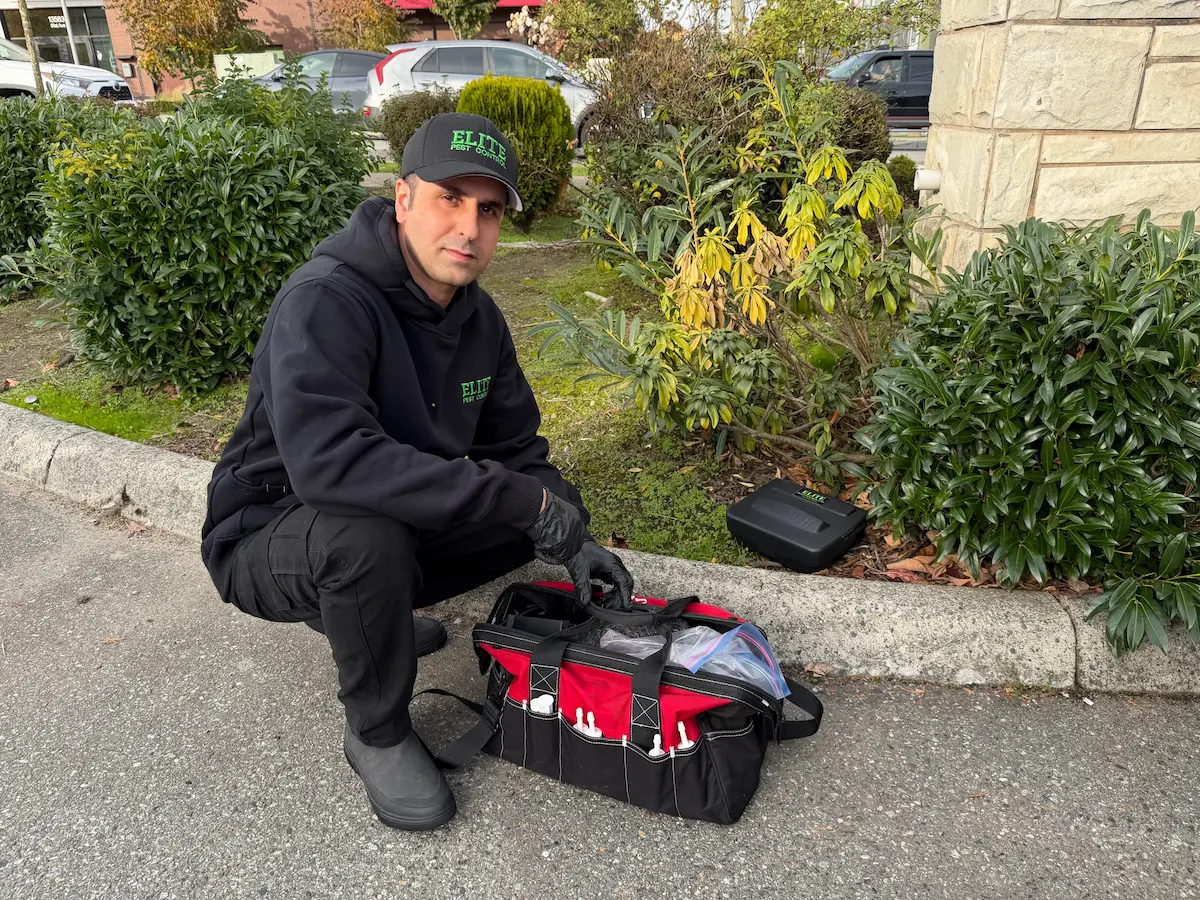
Hassan handles mole jobs across Surrey, South Surrey, Cloverdale, White Rock and Delta. He has walked more soggy Lower Mainland lawns than he can count, and he can usually tell within a few minutes whether you are dealing with a mole, a vole or something else. His job is not to scatter traps and hope: it is to find the tunnels the mole actually uses every day and work those.
Getting the animal right matters, because the fix is completely different.
| Mole | Vole | |
|---|---|---|
| Looks like | Velvety dark grey fur, tiny eyes, no visible ears, big paddle-shaped front feet for digging | A stocky mouse: short tail, small ears, rounded face, brown coat |
| Eats | Earthworms, grubs and soil insects. Moles don’t eat your plants | Plant roots, stems, bulbs, seeds and tree bark |
| What you see | Volcano-shaped molehills and raised ridges across the lawn | Golf-ball-sized holes, narrow runways (2.5 to 5 cm wide) through matted grass, chewed bark at tree bases |
| Damage | Torn-up lawn, roots left hanging in air pockets, uneven ground | Plants that wilt or tip over because the roots were eaten, girdled shrubs and fruit trees |
In Surrey, the mole you are dealing with is almost always the coast mole. BC’s other species, the Townsend’s mole, is endangered and found in Canada only in a small area near Huntingdon and Abbotsford. It is the largest mole in North America and leaves noticeably bigger mounds. Identifying the species before any trapping is part of doing this job responsibly.
Pocket gophers, which cause mole-like mounds elsewhere in North America, are not a Lower Mainland problem. If you see small open holes and chewed or toppled plants rather than mounds, a vole is more likely, often travelling through an old mole tunnel.
One mole can produce a surprising number of hills. Most yards have only one or two.
Moles don’t hibernate. They are active all year, but you see the most damage in spring and fall, when the ground is moist and earthworms are near the surface. Surrey’s long wet season keeps lawns soft and full of worms, which is exactly what moles want. Spring is mating season, and females have one litter a year, usually born between late March and early May. In a hot, dry summer, moles go deeper and the hills slow down, then they come back with the fall rain.
That makes fall and early spring the best time to act: the tunnels are busy, so they are easier to find and work.
Almost every homeowner tries something first. Here is what we hear about most, and what actually happens:
The common thread: none of these deal with the actual animal in its main tunnel.
Every mole job follows the Elite Seal standard: inspect, eliminate, exclude, prevent.
Most residential yards are cleared within a few visits.
Moles move in because a lawn is healthy, moist and full of worms, so a neighbour’s mole can always wander over. Long-term protection comes from a few things working together:
Voles are rodents, not moles, so they need a different plan. Mole traps won’t catch them, and vole damage is to your plants rather than your lawn’s surface. If Hassan finds voles during the inspection, the job switches to a rodent control approach:
Not sure which one you have? Send a couple of photos with your estimate request and we’ll tell you before we arrive.
Every yard is different, so we quote after a quick look at your property. The price depends on:
Estimates are free, and we confirm the price before any work starts. Call 778-939-6064 for a quote.
Molehills don’t stop on their own, and every week a mole has to dig, the lawn repair gets bigger. Call 778-939-6064 or request a free estimate online. Same-day service is available 7 days a week across Surrey, South Surrey, White Rock and Delta, including pest control Delta and pest control White Rock homes.
Get my free estimate Call 778-939-6064
Every yard is different. The price depends on the size of your yard, how many active areas there are and how long the moles have been established. Estimates are free, and we confirm the price before any work starts.
Moles leave volcano-shaped dirt mounds and raised ridges, and they don’t eat plants. Voles leave small open holes, narrow runways through the grass and chewed roots or bark.
No. Moles are active all year. In Surrey, most damage shows up in spring and fall, when the ground is moist and earthworms are close to the surface.
Most DIY options, like sonic spikes, castor oil, gum and flooding, don’t work reliably. Moles rarely take poison bait. Professional trapping in the main tunnels is the most effective approach.
Most yards are cleared within a few visits once the active tunnels are found. Large or long-established yards can take longer.
We find where they came in, protect beds with underground barriers, and give you a lawn plan. If a new mole shows up, calling early keeps it a quick fix.
Related: Rodent control in Surrey · Pest control services · Pest control in Delta · Pest control in White Rock